
Preparing for IIT-JEE is not just about studying for long hours. It is about understanding concepts, practising the right questions, identifying weaknesses, and using your time effectively. With a vast syllabus covering Physics, Chemistry, and Mathematics, students often struggle to decide what to study, how much time to spend on each subject, and how to measure their progress.
This is where Artificial Intelligence (AI) can make a difference.
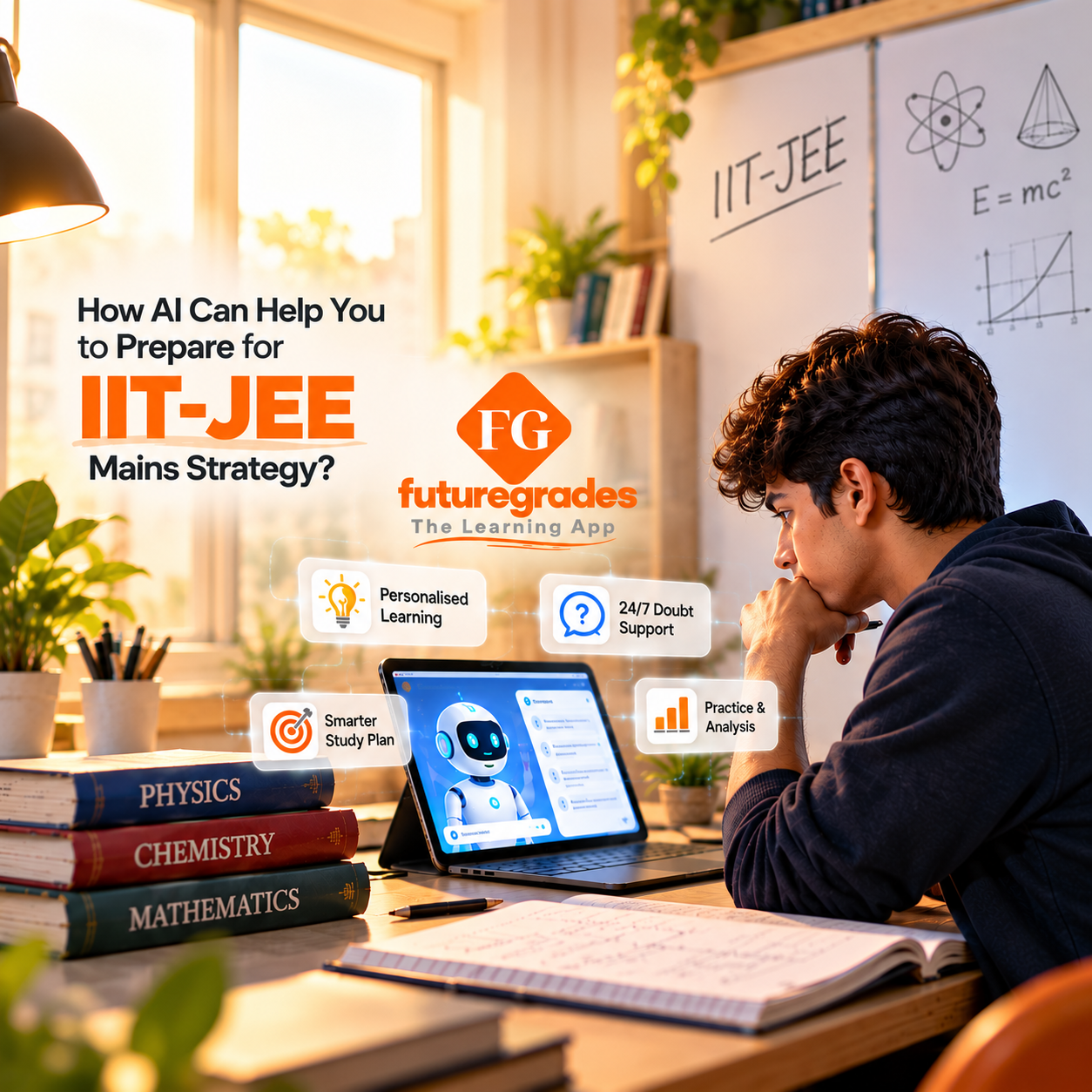
AI is transforming the way students learn by making education more personalised, interactive, and data-driven. When used correctly, it can help IIT-JEE aspirants develop a smarter preparation strategy instead of relying only on long study sessions.
1. Personalised Learning for Better Understanding
Every student has a different learning style. Some students understand Physics concepts quickly but struggle with Mathematics, while others need additional practice in Organic Chemistry.
Traditional learning methods may not always address these individual differences. AI-powered learning platforms can help students identify their learning gaps and focus on areas that require more attention.
For example, if a student repeatedly makes mistakes in rotational motion, an AI learning tool can help them revisit the relevant concepts, practise similar questions, and strengthen their understanding.
This approach makes learning more focused and helps students avoid spending unnecessary time on topics they have already mastered.
2. Get Doubts Solved Anytime, Even at Midnight
One of the biggest challenges during IIT-JEE preparation is getting stuck on a difficult question when immediate guidance is unavailable.
Waiting until the next coaching class can interrupt the learning process and create unnecessary confusion.
AI-powered learning platforms can provide on-demand assistance, allowing students to ask questions, clarify concepts, and explore step-by-step explanations whenever they need help.
Whether a student is revising Physics at 6 AM or practising Mathematics at 2 AM, an AI tutor can offer learning support without being restricted to conventional classroom hours.
However, students should also learn to solve problems independently rather than depending entirely on AI-generated answers.
3. Identify Weak Areas Before They Become Bigger Problems
Many students spend hours studying without knowing whether they are making meaningful progress.
AI can help analyse practice performance, quiz results, and recurring mistakes to highlight topics that need improvement.
For instance, a student may perform well in Chemical Bonding but consistently lose marks in Equilibrium. Recognising this pattern early allows the student to adjust their study plan and dedicate more time to the weaker topic.
Instead of preparing every chapter with equal intensity, students can prioritise their efforts according to their understanding, accuracy, and exam requirements.
The goal is simple: study smarter by understanding where improvement will have the greatest impact.
4. Create a Smarter and More Structured Study Plan
An effective IIT-JEE preparation plan requires a balance between learning new concepts, revising previous chapters, practising questions, and taking mock tests.
AI can help students organise these activities into a practical study schedule based on their available time and preparation level.
A structured plan might include:
- Learning a new concept and reviewing its fundamentals.
- Solving basic questions before progressing to advanced problems.
- Revising previously studied chapters at regular intervals.
- Practising previous years' questions.
- Taking timed mock tests and analysing the results.
- Revisiting topics where mistakes occur frequently.
Students can also use AI tools to reorganise their schedules when school examinations, unfinished chapters, or unexpected commitments affect their routine.
A realistic and consistent plan is usually more effective than an extremely ambitious timetable that is difficult to follow.
5. Practise According to Your Current Preparation Level
Solving hundreds of random questions does not automatically guarantee better results. The quality and relevance of practice matter just as much as the quantity.
AI-powered learning tools can help students practise questions based on their current understanding and gradually increase the difficulty level.
For example, a student who is learning electrostatics can begin with fundamental questions, move towards application-based problems, and then attempt challenging JEE-level questions.
This gradual progression helps build conceptual clarity and problem-solving confidence.
Students should also practise previous years' IIT-JEE questions and use official exam patterns as a guide. AI-generated questions can supplement this practice, but they should not replace reliable examination material.
6. Learn from Every Mock Test
Mock tests are an essential part of IIT-JEE preparation, but their real value lies in analysing the results.
Simply checking a score does not explain why marks were lost.
AI tools can help students organise their mistakes into categories such as:
- Conceptual errors
- Calculation mistakes
- Misinterpretation of questions
- Poor time management
- Incorrect question selection
- Lack of revision
Suppose a student knows how to solve a problem but repeatedly makes calculation errors under time pressure. Their preparation strategy should focus on accuracy and timed practice rather than studying the same concept repeatedly.
By analysing mistakes after every mock test, students can turn each test into an opportunity for improvement.
7. Make Revision More Effective with AI
Revision is often one of the most neglected parts of competitive examination preparation. Students may understand a chapter when they first study it but forget important formulas, reactions, and concepts several weeks later.
AI can help generate personalised revision questions, flashcards, formula summaries, and short quizzes from study material.
For example, students can use AI to create a quick revision quiz on thermodynamics, practise important organic chemistry reactions, or review key mathematical identities.
Combining these resources with spaced revision, active recall, and regular question-solving can improve retention and make revision sessions more productive.
Students should always verify formulas, facts, and explanations against trusted textbooks and their coaching material.
8. Manage Time and Reduce Unproductive Study Hours
Long study hours are not always a sign of effective preparation. Frequent distractions, repeated revision of familiar topics, and unplanned study sessions can reduce productivity.
AI can help students organise tasks, set daily goals, track completed activities, and identify topics that require additional practice.
For example, instead of setting a vague goal such as “study Physics today,” a student can create a more specific target:
- Revise the laws of motion.
- Solve 25 relevant practice questions.
- Analyse incorrect answers.
- Review mistakes before ending the session.
Clear goals make progress easier to measure and help students build consistency.
At the same time, students should maintain adequate sleep, regular breaks, physical activity, and a sustainable routine throughout their preparation.
9. Why Personalised AI Learning Platforms Matter
AI becomes particularly useful when it is integrated into a learning environment designed around the individual student.
A personalised AI learning platform can combine doubt-solving support, practice resources, progress insights, and revision assistance to make preparation more organised.
For IIT-JEE aspirants, this means having additional academic support whenever they need to understand a concept, practise a difficult topic, or review their performance.
Future Grades aims to make learning more accessible through AI-powered educational support, personalised learning assistance, video lectures, and progress reports. Its learning approach can help students make better use of their study time while continuing to build their conceptual understanding.
AI should complement teachers, coaching classes, textbooks, and independent problem-solving. The strongest preparation strategy combines these resources rather than relying on any single tool.
10. Use AI as a Guide, Not a Shortcut
Although AI offers many benefits, students must use it responsibly.
AI-generated explanations can sometimes contain errors, and automatically receiving a solution does not necessarily mean that a student understands the underlying concept.
To use AI effectively for IIT-JEE preparation:
- Attempt a question independently before asking for help.
- Request explanations of the concepts behind a solution.
- Ask for hints before viewing the complete answer.
- Verify important information using trusted academic resources.
- Practise similar questions without assistance.
- Review mistakes and track improvement over time.
The objective is not to make AI solve every problem. It is to use AI to become a better problem-solver.
Conclusion: Prepare Smarter, Practise Better, Perform with Confidence
Cracking IIT-JEE requires discipline, conceptual clarity, consistent practice, and the ability to learn from mistakes. AI can support all these areas by helping students personalise their learning, resolve doubts, organise revision, analyse mock tests, and make more informed decisions about their preparation.
The real advantage comes from using technology strategically. Students who combine AI-powered assistance with independent thinking, quality study material, regular mock tests, and guidance from experienced teachers can build a more structured and effective preparation routine.
With its focus on AI-powered learning and personalised academic support, Future Grades encourages students to make learning more accessible, flexible, and student-centred.
Because successful preparation is not simply about studying harder. It is about understanding better, practising consistently, and making every study session count.
Written by FutureGrades Publisher
Verified Educatorpublisher
Dedicated educator contributing to futuregrades' mission of making high-quality, personalized competitive exam preparation accessible to every Indian student.